
The electroweak force is pretty romantic because it's really the unification of two forces, electromagnetic force, and the weak force. At really high (like, universe-creating high) energy, they're the same thing, but at energies where you and I live, they look pretty different, so we'll talk about them separately.
1. Electromagnetic force:
The electromagnetic force is 1037 (*ahem* that's a 1 with 37 zeroes after it) times stronger than the gravitational force that keeps you anchored to the earth. So for the record, if you want to compliment someone, telling them you're magnetically attracted is making a stronger point than telling them that you gravitate toward them.
They say opposites attract, and whether that's true in love or not, the electromagnetic force causes opposite charges and opposite magnetic poles to be attracted to each other. North poles of a magnet are attracted to south poles, and positive charges are attracted to negative charges. On the other hand, the same force causes things with like magnetic polarity or like electrical charge to be repulsed. The electromagnetic force causes electrons to be attracted to the nucleus in atoms. It also causes protons in the nucleus to be repulsed by each other. The nucleus stays together regardless of this repulsion between positive charges because of the strong force, which we will discuss in a future post.

|
| Electromagnetic force causes opposites to attract... At least when it comes to magnets and electrical charges. |
Quantum electrodynamics says that massless virtual photons mediate the electromagnetic force. All four fundamental interactions are mediated by different particles, the mass of which determine the range of the interaction. Massless particles, gravitons and photons, mediate gravitation and electromagnetism, respectively, so the range is essentially infinite. Of course, the strength of the field drops in an inverse square relationship with the distance from the source, so at large distances from the source, the force becomes extremely weak and we tend to largely ignore them. In other words, physical separation does not "make the heart grow fonder," at least not when it comes to electromagnetism.
2. Weak force
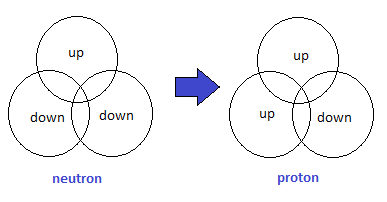
The weak force also relies upon exchange of extremely massive mediating particles called W particles, and has an extremely limited distance (~10-18 m). Quarks (the stuff that protons and neutrons are made of) come in six different "flavors," (strange, charm, up, down, top, and bottom) and the weak force is the way quarks change flavors.
|
| Flavor changes by the weak force |
The weak force is important in things like beta emission, a kind of radioactive decay. Protons and neutrons are composed of up and down quarks. Protons are two up quarks and one down quark, and neutrons are two down quarks and one up quark. In the process of beta emission, a down quark of a neutrons changes to an up quark, changing a neutron into a proton. In addition to the emission of a beta particle (now we know it is an electron) and a neutrino, this flavor change results in the transmutation of an atom, changing its identity from one element to another element. For example, Carbon-14 in living organisms (and otherwise) decays to Nitrogen-14 over time. Carbon dating (the only type of dating some people will ever do *zing*) takes advantage of the steady decay of Carbon-14 to Nitrogen-14 to estimate the age of things like bone fragments and wood artifacts.
Stay tuned, because in the next installment we will talk about the strong force, which is the strongest of all four fundamental forces of nature.